Introduction: A Sign of Progress in a Complex Region
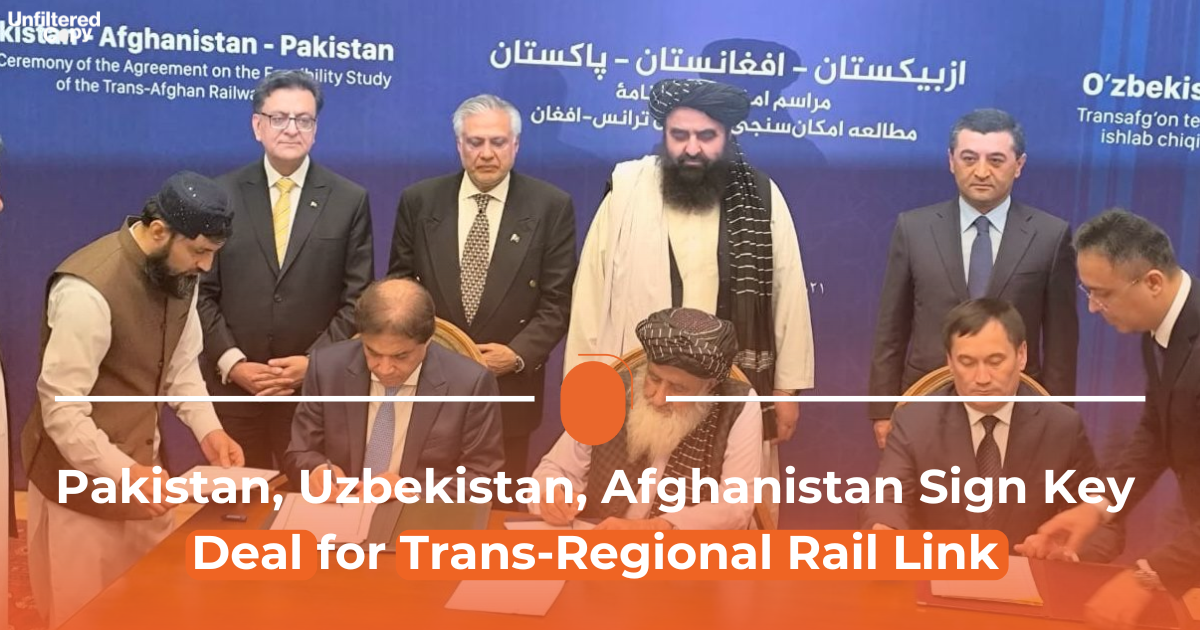
In a significant development for South and Central Asian geopolitics, the foreign ministers of Pakistan, Uzbekistan, and Afghanistan gathered in Kabul on Thursday to ink a pivotal agreement. The deal commits the three nations to a joint feasibility study for a transformative railway project—the Uzbekistan-Afghanistan-Pakistan (UAP) Railway Corridor. This move signals a powerful, shared ambition to transcend historical regional complexities through concrete economic cooperation, potentially redrawing the map of trade and connectivity.
The Anatomy of the Agreement: What Was Signed?
The core outcome of the Kabul meeting was the signing of a “Framework Agreement on the Joint Feasibility Study.” This is a critical first technical step, moving the ambitious rail project from a political vision into the realm of actionable planning. The study will examine the practicalities of constructing the “Naibabad-Kharlachi” rail link, a key segment of the broader UAP corridor.
Pakistan’s Deputy Prime Minister and Foreign Minister, Ishaq Dar, hailed the signing as a historic moment. In a post on X, he congratulated the three nations and emphasized that the project remained a “top priority.” He credited the momentum to the directive of Prime Minister Shehbaz Sharif, revealing that the groundwork was laid during his previous tenure as finance minister.
Mapping the Route: The Proposed UAP Corridor
The envisioned railway promises a direct artery for goods and people. The proposed route is strategically clear:
- Origin: Termiz, a key city in southern Uzbekistan already connected to Central Asia’s rail network.
- Through Afghanistan: Passing through the major commercial hub of Mazar-i-Sharif and the Logar province.
- Entry into Pakistan: Crossing the border at the Kharlachi pass in Pakistan’s Khyber Pakhtunkhwa province.
- Destination: Ultimately connecting to Pakistan’s extensive rail network and the seaports of Karachi, Gwadar, and Bin Qasim.
This path is not chosen at random. It seeks to utilize existing transport corridors where possible and create the shortest, most efficient link between Central Asia and the warm waters of the Arabian Sea.
The “Why”: Strategic and Economic Imperatives
The driving force behind this trilateral push is a confluence of powerful economic and strategic incentives:
- Access for Landlocked Nations: For Uzbekistan and other Central Asian Republics, this corridor offers a reliable, shortest-path alternative to traditional routes through Iran or Russia, unlocking greater trade autonomy and economic potential.
- Pakistan’s Geo-Economic Vision: The project is a cornerstone of Pakistan’s pivot to a “geo-economic” strategy. By positioning itself as a vital transit hub, Pakistan aims to boost revenue from transit fees, increase port activity, and stimulate economic zones along the route.
- Afghanistan’s Stabilization Hope: For the Afghan interim government, such large-scale infrastructure projects represent a crucial source of potential investment, job creation, and legitimization through regional engagement. It ties Afghanistan’s future to cooperative economic partnerships.
- Regional Integration: Beyond bilateral trade, the corridor is framed as a catalyst for broader economic integration across the region, enhancing cross-border supply chains and people-to-people contacts.
Challenges on the Track: The Road Ahead
While the agreement is a major diplomatic success, the path forward is paved with significant challenges that the feasibility study must rigorously address:
- Security Concerns: The Afghan section, in particular, traverses regions where ensuring the long-term security of infrastructure and cargo is paramount.
- Funding and Financing: As a multi-billion-dollar endeavor, securing investment from international financial institutions and private partners will be a monumental task, heavily dependent on risk assessments.
- Technical Hurdles: The varied and often difficult terrain, along with the need to harmonize technical standards (rail gauge, signaling systems) across three countries, presents engineering and logistical complexities.
- Political Sustainability: The project requires sustained political will across multiple administrations in all three countries over a decade or more—a non-trivial commitment in a dynamic region.
The Broader Diplomatic Context
Minister Dar’s day-long visit involved more than just the signing ceremony. His meetings with Acting Afghan Foreign Minister Amir Khan Muttaqi and other officials covered the full spectrum of bilateral relations. According to Pakistan’s Foreign Office, both sides stressed maintaining momentum and expanding cooperation in trade, transit, and—significantly—security. This highlights an understanding that the railway’s success is inextricably linked to overall stable and cooperative relations, particularly between Kabul and Islamabad.
Conclusion: A Bold Step Toward a Connected Future
The signing of the UAP railway feasibility agreement is more than just a procedural formality. It is a bold statement of intent from Pakistan, Uzbekistan, and Afghanistan. It demonstrates a shared willingness to bet on a future defined by connectivity and mutual economic benefit rather than division.
The feasibility study will now serve as the reality check, quantifying the costs, risks, and rewards. Regardless of the final outcome, this collaboration itself marks progress. It builds diplomatic capital, fosters technical cooperation, and keeps alive a vision of a region woven together by steel tracks, offering a tangible promise of prosperity that could help pave the way for greater stability in one of the world’s most crucial crossroads.