Introduction: When Public Funds Lack Public Clarity
In a nation where fiscal austerity is frequently preached to the public, the revelation of opaque spending by its leaders strikes a particularly discordant note. A recent audit report by the Auditor General of Pakistan (AGP) has cast a stark spotlight on the financial privileges enjoyed by Members of the National Assembly (MNAs), uncovering a web of discrepancies totaling hundreds of millions in travel vouchers. The findings go beyond a simple accounting error; they speak to a systemic failure in transparency and accountability at the very heart of the country’s legislative body.
The Core Finding: A Billion-Rupee Benefit with a Missing Rs161 Million
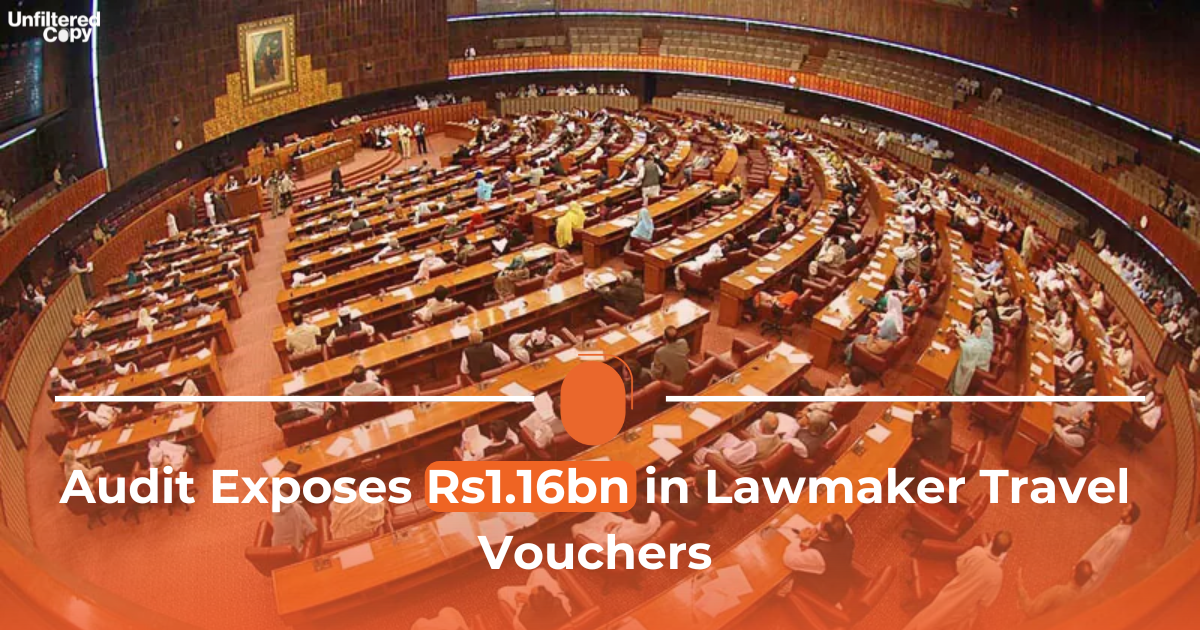
The AGP’s scrutiny focused on the “privilege travel vouchers” issued to MNAs from the financial years 2021-22 to 2023-24. These vouchers are a significant perk, allowing lawmakers to claim air travel reimbursements. The audit revealed a jaw-dropping headline figure: Rs1.16 billion worth of vouchers were issued in just three years.
However, the more alarming discovery lay in the mismatch. While the National Assembly Secretariat officially reported an expenditure of Rs1 billion for reimbursing these vouchers, the audit trail told a different story. Cross-referencing data from the State Bank of Pakistan (SBP) and the Accountant General Pakistan Revenues (AGPR), auditors found they could not account for Rs161 million. This gap—where the money was drawn but not clearly spent as reported—is the crux of the irregularity flagged by the AGP.
The Auditor’s Verdict: “Irregular and Unauthorised”
The AGP did not mince words. The report explicitly termed the lapse as “irregular and unauthorised.” This formal language from the country’s top audit authority indicates a serious breach of financial rules and procedures. The core failure, as outlined, was the National Assembly Secretariat’s inability to perform a basic yet crucial accounting function: reconciliation.
In simpler terms, the secretariat was spending money (issuing vouchers and processing reimbursements) without adequately matching its own records with the confirmations from the central bank and the federal treasury. This deficiency points to what the report describes as weak “internal controls over financial reporting.” Essentially, the checks and balances designed to prevent errors or misuse were either absent or ineffective.
The Official Response: Silence and Slow Reconciliation
When sought for an official comment, the National Assembly Secretariat chose not to respond on the record—a reaction that often fuels public skepticism. Behind the scenes, however, the audit process has triggered a mandated corrective action. The Departmental Accounts Committee (DAC), a body that reviews audit objections, directed the NA management in January 2025 to reconcile the figures and present the relevant records.
An official, speaking on condition of anonymity, acknowledged the process is underway but cited it as “time-consuming.” The official added a telling detail: the majority of the pending reconciliation cases involve MNAs from the provinces of Sindh and Balochistan. This geographical detail, while not explanatory in itself, invites questions about whether procedural inconsistencies or oversight were more prevalent in certain regions.
The Broader Implications: Trust, Transparency, and Taxpayer Money
This audit observation is not an isolated incident but part of a persistent pattern of financial mismanagement observed in various government departments. However, its occurrence in the National Assembly—the institution responsible for overseeing the national budget and holding the executive accountable—carries a unique weight.
- Erosion of Public Trust: When lawmakers, who are custodians of public funds, are seen to benefit from a system with lax financial controls, it severely damages the social contract between citizens and the state.
- The Privilege Debate: The sheer scale of the benefit—Rs1.16 billion—reignites the perennial debate about the extensive privileges awarded to elected officials, especially in an economy where millions struggle with basic needs.
- Accountability Deficit: The slow, opaque reconciliation process and the initial reluctance to comment publicly exemplify an accountability deficit. It raises the question: if this is the transparency for MNA expenses, what confidence can the public have in the management of trillion-rupee national projects?
The Way Forward: Beyond Reconciliation
While reconciling the Rs161 million discrepancy is a necessary first step, it cannot be the final one. This audit observation must serve as a catalyst for systemic reform within the parliamentary administration.
- Digital and Automated Systems: Manual, paper-heavy processes are prone to error and obfuscation. Implementing a fully digital, transparent system for tracking and reconciling all parliamentary expenditures is non-negotiable.
- Proactive Disclosure: The details of MNA entitlements and their utilization should be proactively published on the National Assembly’s website in an open-data format, moving beyond reactive responses to audit queries.
- Strengthening Internal Audit: The internal audit wing of the Parliament needs enhanced capacity and independence to act as a real-time watchdog, not a post-facto recorder.
Conclusion: A Test of Parliamentary Integrity
The Rs1.16 billion travel voucher saga is more than an accounting footnote; it is a test. It tests the National Assembly’s commitment to the principles of transparency and accountability it is meant to legislate for the entire country. A swift, transparent resolution and the implementation of concrete reforms to prevent a recurrence are essential. The credibility of Pakistan’s highest democratic forum depends on its ability to manage its own finances with an integrity that sets a standard for all other institutions to follow. The public, whose money is at stake, is watching closely.