Introduction: Faith Confronts Security
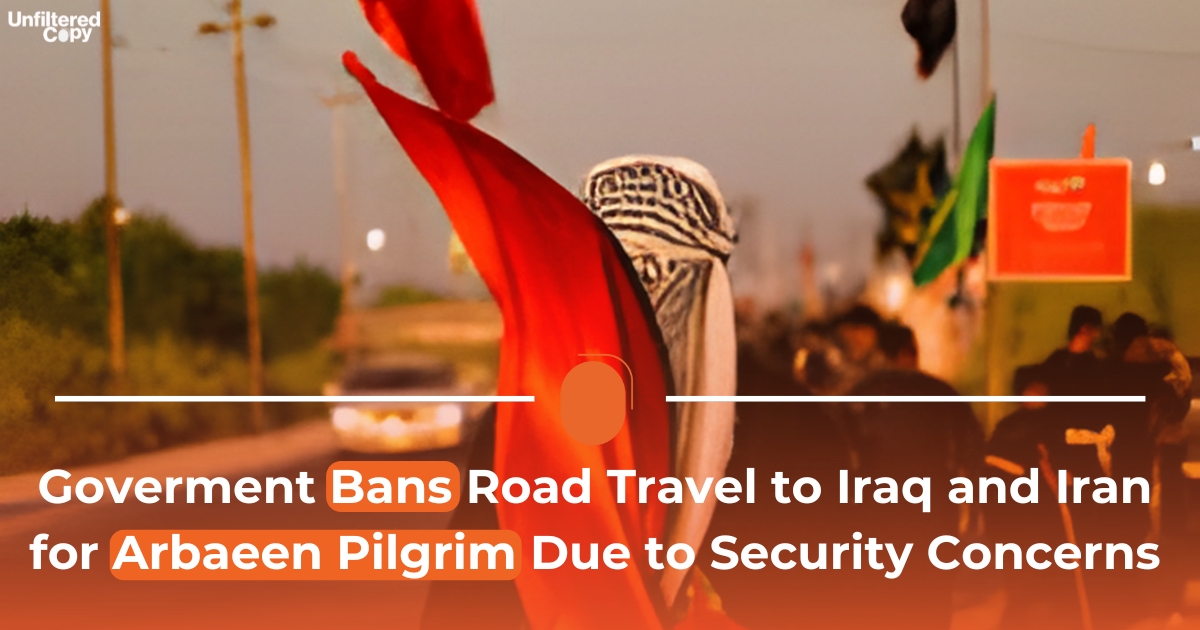
The Arbaeen pilgrimage, marking forty days after Ashura, is one of the largest annual religious gatherings in the world, drawing millions to the holy cities of Karbala and Najaf in Iraq. For decades, a significant portion of Pakistani Shia Muslims have undertaken this journey by road, traversing through Iran into Iraq in massive convoys. This year, however, that tradition has been abruptly halted. The Pakistani government’s announcement of a complete ban on road travel for Arbaeen pilgrims to Iraq and Iran is a profound decision that sits at the tense intersection of faith, security, and state responsibility.
The Official Announcement: A Decision Rooted in “Public Safety”
The ban was formally declared by Interior Minister Mohsin Naqvi via a statement on X (formerly Twitter). The language was unequivocal: the restriction was imposed “purely in the interest of public safety and national security.” This followed what the government described as “extensive consultations” with a high-level committee including the Ministry of Foreign Affairs, the Balochistan Government, and the country’s key security agencies. The decision points directly to “ongoing regional security challenges and threats along the land routes,” without specifying details but implying a risk level deemed unacceptable for civilian travel.
The Security Calculus: Reading Between the Lines
While the official statement is sparing in specifics, regional geopolitics and Pakistan’s internal security landscape provide context. The overland route from Balochistan into southeastern Iran and onward to Iraq is notoriously perilous. It traverses terrains known for:
- Cross-Border Militancy: The region is a hotbed for militant groups and separatist outfits active in both Pakistani and Iranian Balochistan, who have previously targeted passenger buses and security forces.
- Regional Instability: Tensions in the Middle East, particularly involving Iran and its proxies, create a volatile atmosphere where large, identifiable convoys of pilgrims could be vulnerable.
- Kidnapping for Ransom: The routes have seen incidents of criminal gangs kidnapping travelers for ransom.
- Logistical & Medical Risks: The journey is physically grueling, and managing medical emergencies or accidents in remote areas is a colossal challenge for the state.
The government’s move is a pre-emptive risk mitigation strategy. By centralizing travel through airports, authorities can better vet travelers, manage logistics, and avoid the immense security apparatus required to protect hundreds of buses strung across hundreds of miles of hostile territory.
The Alternative: A Pivot to Air Travel
Recognizing the religious and emotional significance of Arbaeen, the ban was coupled with a critical assurance. The government has committed to facilitating the pilgrimage through air travel. Prime Minister Shehbaz Sharif personally directed concerned authorities to arrange the “maximum number of flights” to accommodate pilgrims in the coming days.
This pivot serves multiple purposes:
- Enhanced Security: Airports offer controlled environments for security screening and passenger management.
- Predictable Logistics: Flight schedules allow for orderly movement, reducing the chaos and strain associated with massive road convoys.
- Diplomatic Coordination: It simplifies coordination with Iran and Iraq on pilgrim entry and reception at designated airports.
However, this shift also presents new challenges. Air travel is significantly more expensive than the bus journey, potentially putting the pilgrimage out of reach for poorer Zaireen. The government has not yet announced any subsidy or special fare structure, a detail the community will watch closely. Furthermore, the capacity of Pakistan International Airlines (PIA) and other carriers to handle a sudden, massive surge in demand to specific destinations will be tested.
Community Reaction and the Balance of Duties
The reaction from the Shia community and religious organizations has been mixed. While many understand the security rationale, there is palpable disappointment and concern. The road journey itself is imbued with spiritual significance—a shared experience of hardship and community that is lost in air travel. There are also anxieties about cost and last-minute logistics, as detailed flight schedules and registration procedures are still pending.
The government’s decision exemplifies the classic state dilemma: balancing the duty to protect citizens with the duty to facilitate their constitutional right to religious practice. By offering an alternative (air travel) rather than a blanket prohibition, it attempts to navigate this tightrope. The effectiveness of this compromise will be judged by the smoothness of the airlift operation and its accessibility to all economic segments of the pilgrim community.
Broader Implications and the Road Ahead
This decision sets a potential precedent for future pilgrimages. It signals a shift in the state’s risk assessment, prioritizing centralized, controlled movement over traditional, decentralized routes. It also underscores the deteriorating security perception of the Pakistan-Iran border region.
For the pilgrims, the coming weeks will be a scramble for tickets and information. For the government, the real work begins now: negotiating flight slots, ensuring affordable fares, setting up efficient visa and facilitation desks, and communicating clearly and repeatedly with the public. The success or failure of this policy will not be in the announcement, but in its execution.
Conclusion: A Journey Transformed
The ban on road travel for Arbaeen marks the end of an era for Pakistani pilgrims. It is a stark acknowledgment that the landscapes of faith and security have changed irrevocably. While the essence of the pilgrimage—the journey to pay homage—remains intact, its character has been fundamentally altered. The government’s ability to manage this transition with sensitivity, efficiency, and equity will determine whether this decision is remembered as a necessary measure for protection or a disruptive imposition. As the sacred time of Arbaeen approaches, all eyes will be on the skies over Pakistan, where faith, once again, finds a way, albeit along a new and different path.